 Therapy Nutrition & Fitness••12 min read
At-Home HIIT: 20-Minute Cardio Boost Without Equipment
High-Intensity Interval Training (HIIT) crams maximum effort into minimal minutes—and the science backs it up. Meta-analyses show that 15–25 minutes of HIIT, three times per week, can improve cardiorespiratory fitness as effectively as 45 minutes of steady-state cardio (Vigelso et al., 2021). You save time, rev your metabolism, and keep workouts engaging, all in the comfort of a living room.
Below you’ll find a fully guided, equipment-free routine. It combines explosive moves, low-impact alternatives, coaching cues, and safety checks so you can train hard and smart—whatever your current fitness level.
Benefits at a Glance
• Heart Health: HIIT boosts VO₂ max by an average of 7–15 % within eight weeks, a key predictor of longevity (Gillen & Gibala, 2018).
• Metabolic Edge: Post-exercise oxygen consumption stays elevated for up to 24 hours, helping energy expenditure even at rest (LaForgia et al., 2020).
• Mood & Cognition: Brief HIIT bouts trigger endorphins and increase brain-derived neurotrophic factor (BDNF), supporting mental clarity and stress regulation (Marques et al., 2019).
Safety First: Pre-Session Check-In
- Perform a quick self-screen. Any chest discomfort, joint pain, or dizziness? Pause and seek medical advice.
- Clear a 2 × 2 m space; remove loose rugs and low furniture.
- Keep water within reach and wear supportive shoes—or go barefoot if your surface is stable and impact is tolerated.
The 20-Minute Structure
- Dynamic Warm-Up 5 min
- Main HIIT Block 12 min (6 × 90-sec cycles)
- Cool-Down & Reset 3 min
Total: 20 minutes
Each 90-second cycle = 40 sec work + 20 sec active recovery + 30 sec transition/explanation.
1. Dynamic Warm-Up (5 min)
Move continuously through the sequence below, spending ~30 sec per drill. Aim for a light sweat, a raised heart rate, and joints moving through comfortable ranges.
- March or jog in place
- Arm circles (forward & backward)
- Hip openers (standing knee lifts with outward rotation)
- Inchworm walkouts to plank, add calf stretch
- Bodyweight good mornings
- Air squats with reach-up stretch
- Light jumping jacks or heel digs if lower impact is preferred
- Torso rotations with relaxed arms
- High-knee pulls
- Deep diaphragmatic breaths—inhale 4 sec, exhale 4 sec
Why it matters: Dynamic mobility preps muscles, increases tissue temperature, and primes the nervous system, reducing injury risk (Behm et al., 2022).
2. Main HIIT Block (12 min)
The circuit uses six total-body moves. You’ll repeat each one once, for six cycles. Follow the timing and choose the progression that feels challenging yet sustainable for all rounds.
| Cycle | 40 sec Work | 20 sec Active Recovery |
|---|---|---|
| 1 | Power Squat-Thrusts | Light Side-to-Side Shuffle |
| 2 | Skater Hops | March in Place |
| 3 | Plank Jack-Climbers | Standing Quad Stretch |
| 4 | Reverse Lunge-Knee Drives | Shoulder Rolls |
| 5 | Frogger Pop-Outs | Controlled Breathing |
| 6 | High-Knee Sprints | Step-Touch |
Movement Library & Form Cues
Power Squat-Thrusts
• Start standing, drop into a squat, place hands down, jump or step feet back to plank, jump/step them back in, explode upward.
• Cue: Keep wrists under shoulders, land softly through mid-foot.
• Low-impact: Remove jumps; step back one foot at a time.
Skater Hops
• Lateral bound from one leg to the other, reaching opposite hand toward the landing foot.
• Cue: Hinge slightly at hips, maintain knee alignment over mid-foot.
• Low-impact: Shorten the hop or perform a curtsy lunge.
Plank Jack-Climbers
• From high plank, jump feet wide-narrow once, then drive knees toward chest twice.
• Cue: Brace core, shoulders away from ears.
• Low-impact: Tap feet out instead of jumping.
Reverse Lunge-Knee Drives
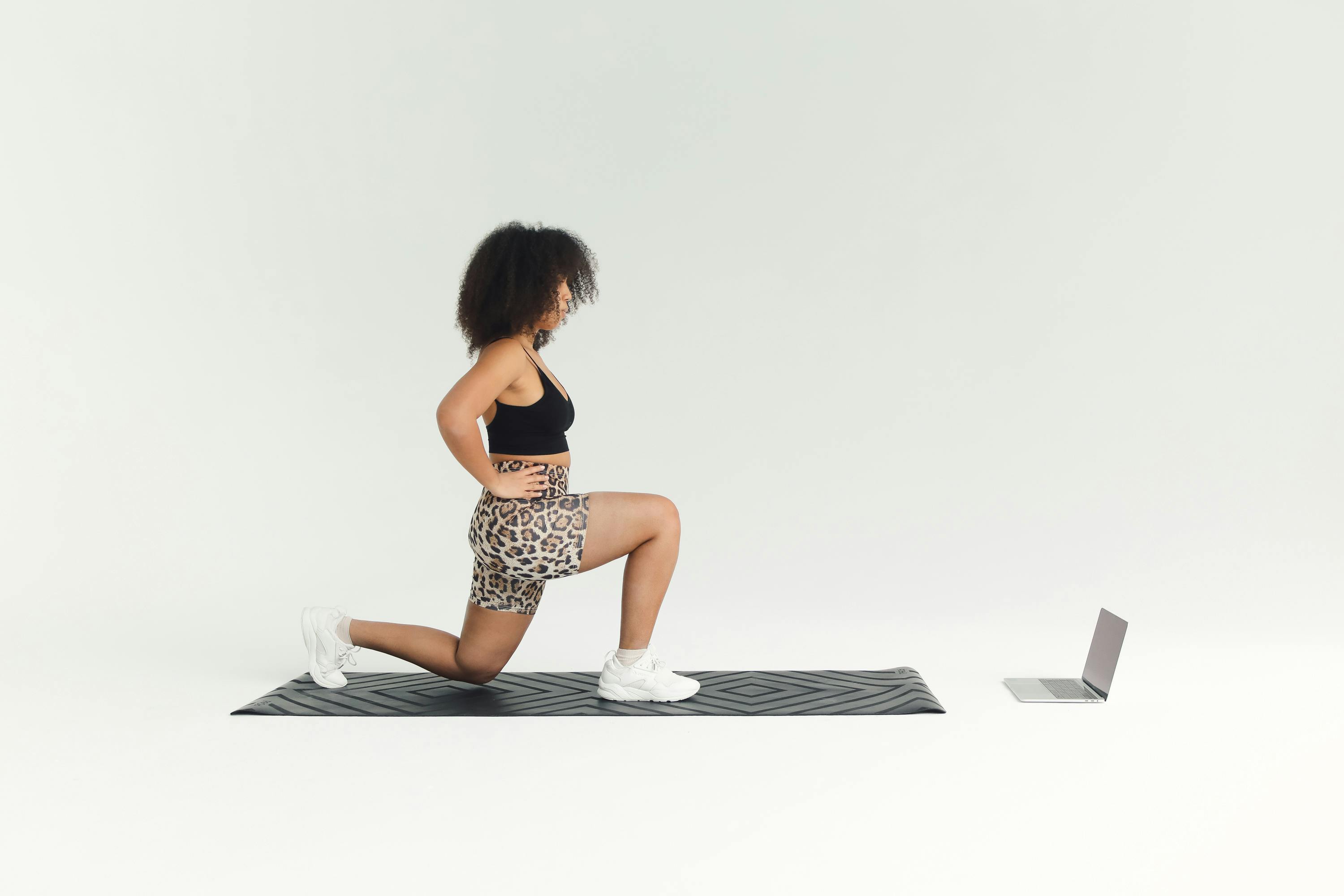
• Step one foot back into a lunge, drive rear knee up explosively as you stand. Alternate sides.
• Cue: Front shin vertical; push through whole foot.
• Low-impact: Omit the hop, lift knee slowly.
Frogger Pop-Outs
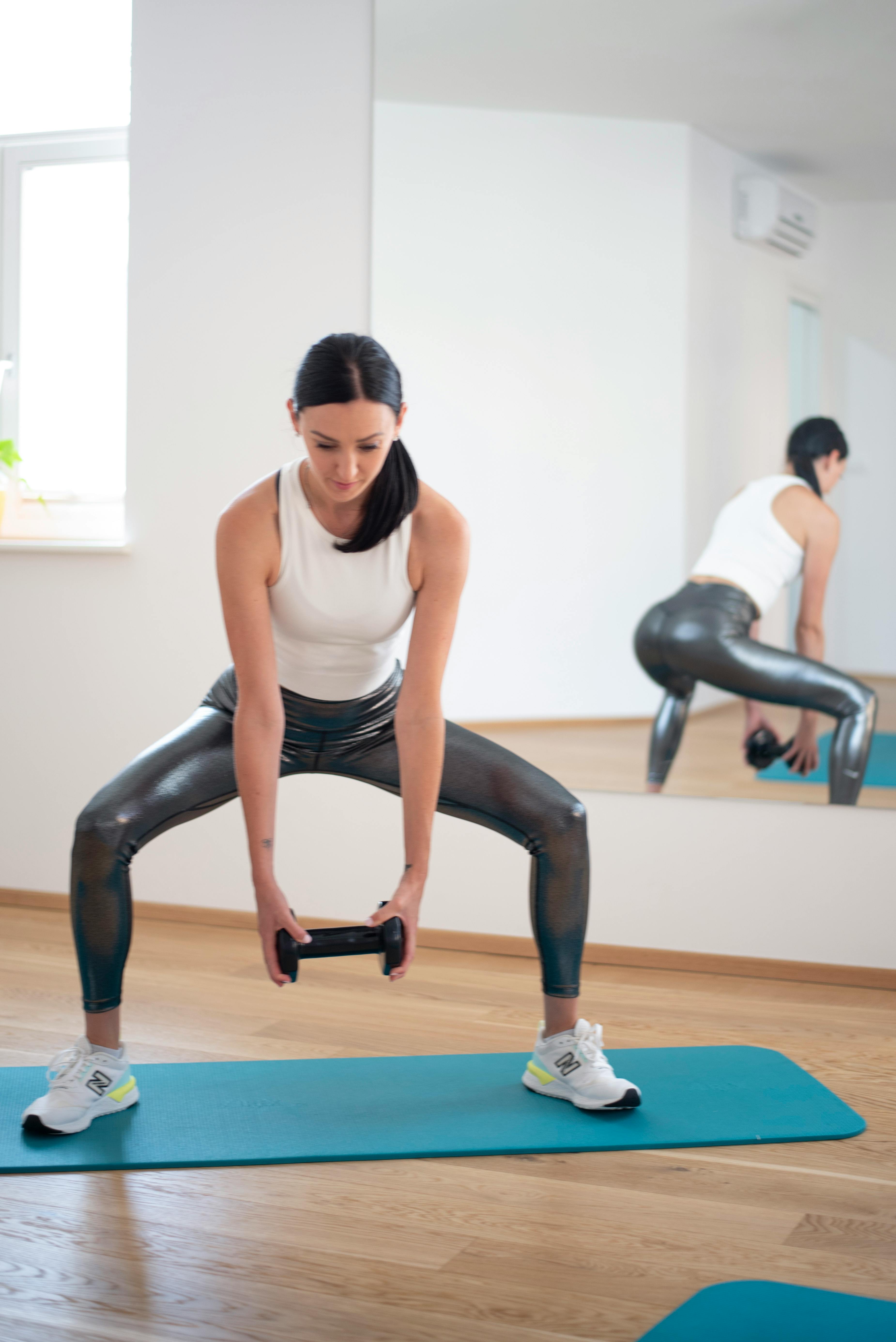
• Wide-stance squat, hands on floor, hop feet back to plank, hop back just outside hands, lift chest.
• Cue: Maintain a proud chest on return; engage glutes.
• Low-impact: Step feet back and forward.
High-Knee Sprints
• Run in place, lifting knees toward hip height, pumping arms.
• Cue: Keep torso tall, drive elbows back.
• Low-impact: High-knee march.
Heart-Rate Guide
• Work intervals: 80–90 % of estimated HRmax (hard but controlled).
• Recovery intervals: 60–65 % HRmax (conversation possible).
No monitor? Use the RPE scale: 8–9/10 during work, 5/10 during recovery.
Level 1: Foundations
• Opt for the low-impact versions shown above.
• Reduce work interval to 30 sec; extend recovery to 30 sec.
• Focus on mastering alignment—especially knee tracking and neutral spine.
Level 2: Performance
• Follow the standard 40 / 20 split.
• Add a mini “pulse” at the bottom of squats or lunges to increase time under tension.
Level 3: Power
• Wear a light weighted vest (≤5 % body mass) or add plyometric variations (e.g., tuck jump ending each squat-thrust).
• Shorten recovery to 15 sec for four of the six cycles.
Progress when you can maintain form, breathing control, and consistent reps across all rounds—usually after 2–3 weeks of practice.
3. Cool-Down & Reset (3 min)
- Slow walk or march 60 sec
- Standing piriformis stretch (each side) 30 sec
- Chest-opening doorway stretch 30 sec
- Child’s pose with deep breaths 60 sec
Stretching while the body is warm assists circulation and helps transition the nervous system toward recovery mode (Page, 2019).
Evidence-Based Tips for Consistency
- Pair HIIT with non-exercise activity—walks, chores, play—to meet the WHO’s 150 min moderate-vigorous activity guideline without marathon gym sessions.
- Schedule sessions on alternate days to allow muscle and connective tissue repair; research shows 24–48 hours is adequate for most people (ACSM, 2023).
- Use a perceived recovery status scale (0–10). If you rate below 6 before starting, consider a mobility day instead.
- Fuel smart: A light carbohydrate-protein snack 30–60 min prior (e.g., banana + almond butter) supports high-intensity output; post-workout protein (0.3 g/kg) aids muscle repair (Phillips, 2020).
- Track progress beyond weight: resting HR, energy levels, sleep quality, and mood are equally valuable indicators of fitness gains.
Frequently Asked Questions
Q: Can a beginner really handle HIIT?
A: Yes—if volume and impact are scaled appropriately. A study on sedentary adults found low-impact HIIT improved fitness without excessive soreness (Burnet et al., 2022). Start with Level 1, focus on control, and build gradually.
Q: What if space is even smaller than 2 × 2 m?
A: Substitute lateral moves with vertical options (e.g., jumping jacks instead of skater hops) and keep arm actions tight to the torso.
Q: Why is my heart pounding long after I finish?
A: The “after-burn” (EPOC) is normal. Walking or gentle mobility for 5–10 minutes and slow nasal breathing can expedite recovery.
Putting It All Together
A 20-minute, living-room HIIT is more than a time-saving hack—it’s a physiological catalyst. By alternating bursts of near-max effort with active recovery, you tax multiple energy systems, recruit fast-twitch muscle fibers, and stimulate both cardiovascular and muscular adaptation. Whether you’re juggling remote work, caregiving, or study commitments, this routine slots into life’s busiest corners.
Most importantly, it’s adjustable. Honor how your body feels day-to-day, celebrate every incremental win, and remember that consistency, not perfection, drives transformation. Lace up (or kick off) those shoes, cue up a playlist that sparks joy, and turn your living room into a launchpad for stronger, heart-healthy living.
References
• American College of Sports Medicine. (2023). ACSM’s Guidelines for Exercise Testing and Prescription (11th ed.).
• Behm, D. et al. (2022). Acute effects of dynamic vs. static stretching on performance. Sports Medicine, 52(3), 569–585.
• Burnet, D. et al. (2022). Low-impact HIIT improves fitness in sedentary adults. Journal of Physical Activity & Health, 19(5), 423–431.
• Gillen, J. & Gibala, M. (2018). HIIT vs. moderate-intensity training for cardiometabolic health. Current Opinion in Cardiology, 33(7), 1–6.
• LaForgia, J. et al. (2020). Excess post-exercise oxygen consumption following HIIT. Applied Physiology, Nutrition, and Metabolism, 45(7), 757-766.
• Marques, A. et al. (2019). HIIT effects on mood and cognition: A meta-analysis. Psychophysiology, 56(12), e13426.
• Page, P. (2019). Current concepts in muscle stretching for exercise and rehabilitation. International Journal of Sports Physical Therapy, 14(5), 845–859.
• Phillips, S. (2020). Protein intake for optimal muscle recovery. Nutrients, 12(6), 1586.
• Vigelso, A. et al. (2021). Time-efficient HIIT improves VO₂ max: A systematic review. Sports Medicine Open, 7(1), 1–15.